


15 April 1960, the entire SF establishment was formally brought under the Army’s new Combat Arms Regimental System (CARS). This paper scheme initially provided for a maximum of 24 SF Groups, initially all in the Active Component (AC).
77th SFG(A) was deactivated and the unit was reflagged as the 7th SFG(A) on 20 May 1960.
The 7th SFG(A) was organized under TO&E 33-105D, dated 21 Mar 60. This new TO&E brought the Special Forces units in line with the US Army unit organizations and terminology.
The 7th SFG(A) would be the sole unit responsible for training the Soldiers volunteering for Special Forces, until the Special Warfare Center opened in 1962.
7th SFG(A) CDR: Col Donald D. Blackburn
A Co CDR: MAJ Ludwig Faistenhammer
B Co CDR:

1LT Blackburn was an adviser with the headquarters battalion of the 12th Infantry Regiment when the Japanese invaded the Philippines on 8 Dec 1941. LT Blackburn and Major Russel Volckmann evaded to Northern Luzon and spent the next 3 years organizing and leading a Guerrilla force until the liberation of the Phillipines in 1944. COL Blackburn commanded the 7th SFG(A) from April to Aug 1960.
BG Donald Blackburn

From Tulsa Oklahoma, LT Edwards served in the 517th PIR, 17th ABN in WW2. MAJ Edwards served in the 7th ID during the Korean War. LTC Edwards was 77th SFG(A) Commander, when he was replaced by COL Blackburn in Dec 1958. COL Edwards would then replace COL Blackburn as 7th SFG(A) Commander in Aug 1960.
COL Irwin A Edwards
7th SFG(A) Operation ZAPATA-1961
On 17 March 1960, President Eisenhower authorized a 4-part program the CIA had developed to bring about the replacement of the Castro regime by covert means. In the summer of 1960 the concept for the operation began to change from a covert operation to more of an overt military invasion, operation ZAPATA was born. The CIA Task Force were the first to entertain the thought of a Cuban exile strike-force to land on the Cuban coast in addition to guerrilla actions. The CIA officers began to consider the formation of a small force of infantry (200-300 men) for contingency employment in conjunction with other paramilitary operations, and in June began to form a small Cuban tactical air force.
While CIA agents provided a large part of the paramilitary training, US Army Special Forces also conducted training of the Cuban exiles. Initially the 7th SFG(A) provided training to the Cuban exiles, which consisted of communication, guerrilla operations and sabotage at Fort Randolph in the Panama Canal Zone. Several teams from 7th SFG(A) went to Ft Knox, Kentucky to conduct small arms, heavy weapons and tactics for the Cubans. When the operation grew from guerrilla warfare to a larger more conventional operation, the training moved to Guatemala in December 1960. To support the training in Guatemala, twenty-one additional agents and five staff personnel joined the project and the CIA requested additional trainers from the US Army Special Forces. On January 13, 1961, LTC David Crowe and 38 Soldiers from 7th SFG(A) arrived in the training camp in Retalhuleu, Guatemala, to support the training of the 2506 Brigade. The 7th SFG(A) under the guise of providing training to a “Guatemalan Battalion” to “deter the revolutionary activities against the Ydigoras Government.”
Three months later, the operation began on 15 April 1961 and five days later failed, resulting in 1,197 prisoners and 89 dead from the 2506 Brigade.
4 Americans were killed during the failed operation. Thomas Willard “Pete” Ray, Leo Francis Baker, Major Riley W. Shamburger and Wade C. Gray. These men were part of the 130 men, many from the Alabama Air National Guard, contracted by the CIA and brought to Guatemala in January to train the Cuban pilots and ground crews on the B-26. On the morning of 19 April, six B-26s, four with volunteer American crews, flew a bombing mission against Castro's troops. During the mission 2 American-crewed B-26s were shot down.
The failed Bay of Pigs invasion was a catastrophic foreign policy failure that deeply embarrassed President John F. Kennedy and strained his confidence in his military and intelligence advisers. President John F. Kennedy forced the resignation of top CIA leadership and stripped the CIA of sole operational authority for major paramilitary actions, demanding much tighter civilian and military oversight for future covert plans.
December 1962, Castro and the Kennedy Administration agreed to exchange the 1,113 prisoners for $53 million in food and medicine, to be raised through private donations and corporate sponsorships.


Brigade 2506 Training
Source: latinamericanstudies.org

2506 landing on the Cuban coast at Playa Girón-Bay of Pigs
Source: CIA Report on Bay of Pigs Vol 2

2506 Brigade prisoners

Born in Boston Massachusetts, SSG Mulcahy served as tank mechanic with the Massachusetts National Guard’s 182nd Tank Unit. SSG Mulcahy volunteered for active-duty in 1950, serving in the 82nd ABN. In 1957 SGT Mulcahy volunteered for Special Forces in 1957 and served with 77th SFG(A) and 7th SFG(A) in Laos. SSG Mulcahy's team trained Cuban exiles in Ft Knox, KY.
CSM Robert "Bob" Mulcahy

LTC David Crowe
David B Crowe served in WW2. CPT Crowe was serving with the 82nd Airborne, when he volunteered for Special Forces in 1952, where he served with the 10th SFG(A). Major Crowe served with 10th SFG(A) in Bad Tolz Germany. LTC Crowe served with 77th SFG(A) and 7th SFG(A).

Grayson Lynch, was born in Victoria, Texas. Grayon joined the United States Army during WW2 and was wounded during the D-Day landings and during the Battle of the Bulge. LT Grayson served in the Korean war. CPT Grayson served with 77th SFG(A) on the 2nd rotation of HOTFOOT in Laos. Grayson Lynch, worked for the CIA after retiring from the US Army. Lynch against orders, landed with the Cuban UDTs during the Bay of Pigs operation.
CPT Grayson Lynch
7th SFG(A) Exercises-1961
In 1961, the 7th SFG(A) supported a number of exercises.
Exercise WILLOW FREEZE: A STRAC exerise conducted in Feb 1961, The 10-day exercise in Alaska, where 7th SFG(A), the Eskimo Scouts and troops from the 23rd Infantry were the aggressors against the US the 187th, 82nd ABN.
Exercise UWHARRIE FOREST: Conducted in February 1961, in the Uwharrie National Forest. The 7th SFG(A) detachments infiltrated by parachute and established guerrilla bases from which they organized and trained guerrillas.
Exercise SWIFT STRIKE I: A joint exercise conducted in August, 1961 by the Strategic Army Corps (STRAC), 82nd ABN, 101st ABN, and the USAF to test rapid deployment and Combat readiness of the units. Guerrilla forces figured prominently in this huge exercise that stretched into both North and South Carolina. 7th SFG(A) detachments infiltrated by parachute and established guerrilla bases from which they organized and trained guerrillas.
Exercise UWHARRIE FOREST II: Conducted in June-Aug 1961, 7th SFG(A) provided support for the annual active duty for training of reserve component units. Detachments were sent throughout the country to support the USAR Groups: 9th SFG(A), 13th SFG(A), and National Guard Groups 16th SFG(A), 20th SFG(A) in their summer training programs.
MSG Marcel Neault

From Biddeford, Maine SGT Neault served with the 11th ABN during WW2, serving in the Pacific. SFC Neault joined Special Forces in 1955, serving with 10th SFG(A) in Bad Tolz. MSG Neault served with the 77th SFG(A) in 1957. On 17 Feb 1961, during exercise WILLOW FREEZE, MSG Marcel Neault and SGT Charles Williams, both serving with 7th SFG(A), rescued an USAF Crew Chief during a leaflet drop. The Crew member had mistakely opened the door incorrectly and the door flew off and Airmen were pulled out by the prop blast, the two soldiers jumped onto the legs of the airmen as he was pulled out the door.


7th FG(A) soldiers in Swift Strike I
7th SFG(A) Gallery-HOTFOOT / WHITE STAR-1961
With the French withdraw from their former IndoChina colony and the growing Communist threat, the US DOD and CIA developed a plan for Laos. Project HOTFOOT under the President Dwight D. Eisenhower administration and later under the John F. Kennedy administration. The objective of the CIA/ DOD plan was to improve the capabilites of the Laotian military. Seven U.S. Army Special Forces rotations from July 1959 to October 1962, were the basis of this plan. These SF soldiers came from the 77th SFG(A), 7th SFG(A), and 1st SFG(A). Project HOTFOOT from July 1959 to April 1961, non-uniformed SF teams, worked for Programs Evaluation Office a covert CIA paramilitary mission. Operation WHITE STAR opened April 1961 under the establishment of Military Assistance and Advisory Group Laos. From April 1961, until Oct 1962, uniformed US Special Forces troops trained the Lao military and the Laotian tribes.
7th SFG(A) troops deployed to Laos from April 19, 1961, to October 6, 1961.
Five Soliders from 7th SFG(A) were killed in support of Project WHITE STAR. SFC Gerald Biber, SGT Theodore Berlett, SFC John Bischoff, CPT Warren Moon and SSG Raymond Parks.

7th SFG(A) troops in Laos during Operation White Star
Courtesy of Paul Miraldi

SGT Theodore J. Berlett
From Plattsmouth, Nebraska, SGT Theodore Berlett was killed in a tragic training accident on 28 Jan 1962. SGT Berlett was the Engineer Sergeant on FTT , during the sixth rotation of HOTFOOT/WHITE STAR mission. SGT Berlet was assigned to B Co, 7th SFG(A).
7th SFG(A) Operation WHITE STAR-FTT-59
In early March Pathet Lao troops drove Laotian goverment forces back toward Vang Vieng. Capt. Walter Moon’s four-man Field Training Team FTT-59, of the 7th SFG(A) was attached to the 6th Bataillon d’infanterie (Lao) at Ban Pha Home, about thirty miles north of Vang Vieng. On April 22, 1961, the battalion was subjected to a heavy and accurate artillery barrage from NVA troops supporting the Pathet Lao, and was rapidly flanked at Phou Tesao. The perimeter collapsed and the Pathet Lao quickly overran the battalion positions. CPT Walter Moon, was captured in the initial attack. SFC Bischoff , SGT Biber, were killed in an attempt to breakout. SGT Orville R. Ballinger, escaped through the jungle and linked up with some Lao soldiers. They found a boat and were going downriver when they were surprised and captured by the Pathet Lao seven days later. Capt. Moon tried to escape twice during his confinement, and on the last attempt was wounded in the chest and head. According to Ballinger, Moon’s head injury caused him to be come mentally unbalanced, and after several months of persecution, he was executed in his prison quarters at Lat Theoung by a Meo guard and a Pathet Lao officer on July 22, 1961. SGT Ballinger were eventually released in August 1962.

FTT 59-Team moon, 7th SFG(A) troops in Laos during Operation White Star
Source: Robert McKnight

MAJ Walter H Moon
CPT Walter Moon from Rudy, Arkansas, was assigned to B Co 7th SFG(A). CPT Moon was the commander of FTT 59 in Laos. MAJ Moon was married with 2 children.

SFC John M. Bischoff
From Mountain Rest, South Carolina, SFC John M. Bischoff was assigned to B Co 7th SFG(A). SFC Bischoff was the medic on FTT 59. SFC Bischoff was married.

Sgt. Gerald M. Biber
SGT Gerald M. Biber, from Benkelman, Nebraska, was assigned to B Co 7th SFG(A). SGT Biber was the Radioman on FTT 59 in Laos.
7th SFG(A) Operation WHITE STAR, 14 July 1962
On July 14, 1962, a US Gov't contracted aircraft took off on a flight from Vientiane, Laos, to Saravane, Laos, with a scheduled stop at Paksane, Laos. The aircraft was piloted by Allan Blewett, with SSG Raymond Parks, from Dennison, Ohio, and a Thai interpreter as passengers. SSG Parks was the Weapons Sergeant on FTT-11, part of the 7th rotation on HOT/WHITE STAR mission. The aircraft failed to arrive at Paksane, and no distress signals were received. A four-day search and rescue effort over the plane's route failed to locate a crash site. All three men were declared missing.
SSG Raymond F. Parks

SSG Raymond Parks, from Dennison, Ohio was a Weapons SGT on FTT-11. SSG Parks was married.
7th SFG(A) WHITE STAR, 1962


7th SFG(A) Soliders during White Star operations in Laos.
Photo: Paul Miraldi
US Special Forces troops test fire M-1919 LMGs and BARs
MAJ Cooper, BN Surgeon with 2 Laotian Soldiers
MAJ Faistenhammer with UKN MAAG-Laos officer and Special Forces Soldier
COL Ludwig Faistenhammer

SGT Faistenhammer served as a tank commander in WW2 with the 80th ID, from Aug 1944 to the end of the war. Lt Faistenhammer served as a platoon leader and later Company Commander for the 7th Ranger Company in the Korean war. Major Faistenhammer would serve in Laos, during White Star. LTC Faistenhammer would serve with 5th SFG(A) in Vietnam and 10th SFG(A) Germany.


7th SFG(A) troops in Laos during Operation White Star
Courtesy of Paul Miraldi


LT Paddock during Operation White Star
Source: USASOC Veritas Magazine
SFC Ernie Tabata with Laotian troops during Operation White Star
Source: USASOC Veritas Magazine
SGM Ernie Tabata

Born on Oahu, Hawaii, the son of Japanese immigrants. Ernie Tabata enlisted in the U.S. Army in 1949, and served with the 1st Cavalry Division during the Korean War. In 1961, he began his Special Forces (SF) career with 7th SFG(A). SFG Tabata deployed to Laos with WHITE STAR, later he served three tours of duty in Vietnam, including MACVSOG, and four years in the Republic of China on Taiwan.
COL Alfred Paddock

Born in Moscow, Idaho, and grew up in Bogalusa, LA. LT Paddock graduated OCS in 1958. LT Paddock reported to the 77th SFG(A) at Fort Bragg, NC, in 1959. He graduated the Special Forces Officer Course in May 1960 and deployed with 7th SFG to Laos in 1961, supporting Operation WHITE STAR. From 1962 to 1963, he commanded a Detachment A-323, Company C, 1st SFG, in the Republic of Vietnam, initiating a Civilian Irregular Defense Group program in the Tra Bong district.
7th SFG(A) Documents-HOTFOOT / WHITE STAR
7th SFG(A) troops were sent TDY to Laos from Sep 1961 - Mar 1962, in support of Operation White Star. This was the 6th rotation of Special Forces troops to Laos.
The deployment of 63 troops, consisted of 4 B-teams, supporting 9 FA/FTT teams working with the Loatian Army and the Hmong tribes, in the fight against Pathet Lao and their North Vietnamese allies.
The FA teams in the field operated as split teams, teams divided in half, with 5-7 men per team.
The teams working with the Hmongs in the mountains, stayed in the field for the entire deployment. Their only contact, with the outside world was the CIA-Air American H-34 flights, and their team radios.


7th SFG(A) 180 day TDY Orders, from Sep 1961 - Mar 1962
Courtesy of Art Walker
7th SFG(A) Project BLUE ARROW-Panama-1962
By the end of 1961, Special Warfare Center began to develop an operation under the code phrase, "Project Blue Arrow." to bring a Special Forces unit to permanently to Latin America. The plan was for Headquarters and Headquarters Detachment, and Company D, and other selected augmentation units from the 7th SFG(A) to move from Fort Bragg to the Canal Zone in order to be come the basis for the 8th SFG(A)/8th Special Action Force (SAF) . In January 1962, a Special Forces survey team arrived in the Canal zone to inspect several potential sites for the establishment of the planned Special Action Force. This team considered different locations such as Coco Solo Naval Base, Ft Gulick on the Atlantic side of the Isthmus and Fort Clayton on the Pacific side. The team recommended Fort Gulick, this choice being the most logical because, Fort Gulick was the home of the School of the Americas. The survey team made its recommendation to General Yarborough, the Commanding General of the Special Warfare Center in Fort Bragg, N.C., who agreed with the team’s choice.
In 1962, the 7th SFG(A) was directed to prepare a headquarters detachment and one reinforced Special Forces company for deployment to Panama. This was a permanent change of station (PCS) for the personnel involved and required considerable planning and preparation. Designated as D Company, 7th SFG(A) the advance party departed in May and was followed by three additional increments on 31 July, 15 August and 15 October. An additional 101 officers and enlisted men were trained and deployed in December 1962 to bring the unit in Panama force up to full strength. A section from each of the augmentation detachments was assigned to and accompanied the Special Forces company sent to Panama.
LTC John H Sawyer commanded Company D, 7th SFG(A), until January 1963, when COL Simons took command
On 12th April 1963, D Company 7th SFG(A) would be redesignated as 8th SFG(A) at FT Gulick, Panama Canal Zone with COL Arthur "Bull" Simons as the Commander.
COL Charles "Chuck" Fry

Born in Princeton, Missouri Charles Fry enlisted in the Army in 1951 and served in the Korean War with the 3rd, 25th, and 45th Infantry Divisions. SFC Fry joined U.S. Army Special Forces in 1954, and was assigned to 77th SFG(A). SFC Fry served with 10th SFG(A) in Bad Tolz. in 1957. 1LT Fry was assigned to 8th SFG(A) in Panama in 1963.


COL Simons presenting award to LT Fry
Source: USASOC Veritas
7th SFG(A), D Company Gallery


Orders Reorganizing D Co, 7th SFG(A) into 8th SFG(A)
D Co, 7th SFG(A) unit Guidon
Note: Unassigned Branch Crest, Special Forces wouldn't be a US Army branch until the 1990s.
7th SFG(A) Exercises-1962
In the early 1960s, the US Army went through some major changes. In April 1961, an entirely new concept called ROAD (Reorganization Objective Army Divisions) was introduced, replacing the short-lived Pentomic system that had been integrated in 1957 for the atomic battlefield. The ROAD system offered greater flexibility and improved compatibility with NATO allies. The first ROAD units were organized in February 1962 under draft TOEs, this reorganization was required to be completed across both the Regular Army and reserve components by the end of June 1964. Additionally, on January 18, 1962, President John F. Kennedy signed National Security Action Memorandum (NSAM) 124. This directive mandated that the U.S. military elevate counterinsurgency training, organization, and doctrine to a level equal with conventional warfare.
As the US Army units conducted exercises for the newly reorganized units, the Special Forces Groups at Ft Bragg supported the counter-insurgency component, by operating as guerrillas during the exercises, and the detachments conducted pre-exercise instruction in guerrilla and counterguerrilla techniques for the Active-Duty and Reserve Component unit exercises. In 1962, the 7th SFG(A) supported a number of these exercises.
Exercise GREAT BEAR: The 10-day exercise in Alaska, where 7th SFG(A), the Eskimo Scouts and a company of Canadian Airborne troops were the aggressors against the US Army Alaskan (USARAL) 9th Infantry and the supporting 2nd Infantry Brigade. LT Roger Donlon, future MOH recipient, was a Platoon leader in the E Company, 9th Infantry during the exercise GREAT BEAR.
Exercise SHERWOOD FOREST: Conducted in June in an isolated 200 square mile piece of mountainous rain forest on the Olympic Peninsula in Washington State; with the 32nd Infantry Div, Wisconsin National Guard, which had be activated for Berlin Crisis. 2 weeks prior to the start of the exercise, 4 detachments from the 7th SFG(A) parachuted in to organize and train the Gerlach's guerrillas, the 202 volunteers from the 32nd ID. Brig. Gen. William P. Yarborough, commanding general of the Special Warfare Center at Ft. Bragg, NC, observed Exercise SHERWOOD FOREST and was personally involved in the training.
Exercise SWIFT STRIKE II: Swift Strike II was a yearly joint exercise conducted in June by the Strategic Army Corps (STRAC), 82nd ABN, 101st ABN and 2nd ID, and the USAF to test rapid deployment and Combat readiness of the units. Guerrilla forces figured prominently in this huge exercise that stretched into both North and South Carolina. 7th SFG(A) detachments infiltrated by parachute and established guerrilla bases from which they organized and trained over 100 soldiers acting as guerrillas. Teams from the 5th SFG(A), and the British 22nd SAS also participated in the exercise.
The summer months of 1962, the 7th SFG(A) provided support for the annual active duty for training of reserve component units. Detachments were sent throughout the country to support the USAR Groups: 2nd SFG(A), 11th SFG(A), 12th SFG(A), 13th SFG(A), and National Guard Groups 16th SFG(A), 20th SFG(A) in their summer training programs.

7th FG(A) soldier with Eskimo Scout
Source: US Army Photo

SSG Donald Witt of the Guerrilla Force, wearing a beret-a modifed US Army Utility cap with the brim removed.
Source: Wisconsin National Guard

From Elmwood Park, IL PVT Raymond Nitschke was called to active-duty, in Nov 1961, when the Wisconsin Army National Guard's 32nd Infantry Division, was activated for the Berlin Crisis. PVT Nitschke was assigned to the division's quartermaster company. PVT Nitschke was also a Line backer for the Green Bay Packers and they were in the middle of Football season. Coach Lombardi and the 32nd Commander worked out a deal where Nitschke could fly to the games on the weekends. The Green Bay Packers won the National league Championship in 1961.

From Louisville, KY, PVT Paul Hornung was also called to active duty during the Berlin Crisis, Hornung reported Nov. 14 to Fort Riley, Kan., where he served as a truck driver with the 896th Engineer Company. PVT Hornung who won the Heisman Trophy in 1957, was a Running Back for the Green Bay Packers. Hornung found himself in danger of being AWOL for the Championship game, due to a leave policy. Hornung requested an exception to policy to allow him to play- a request denied by his Commander. Despondent, Hornung called Lombardi with the news. Lombardi, in turn, reached out to President Kennedy, who called Hornung's Commander. "Paul Hornung isn't going to win the war on Sunday," Kennedy said of arranging the leave, "but the football fans of this country deserve the two best teams on the field that day." Hornung scored 19 points that day.

From Rock Springs, WY, PVT Boyd Dowler was called to active-duty, with the Wisconsin Army National Guard's 32nd Infantry Division, was activated for the Berlin Crisis in Nov 1961. PVT Dowler was assigned to Headquarters Battery, 32nd Division Artillery PVT Dowler was also a Wide receiver for the Green Bay Packers and they were in the middle of the season. Coach Lombardi and the 32nd Commander worked out a deal where Dowler could fly to the games on the weekends. The Green Bay Packers won the National league Championship in 1961, demolishing the New York Giants 37-0.

MAJ Gustave "Gus" Kocos
Born in Fond du Lac, Wisconsin. PVT Kocos served with the 11th ABN in occupation duty in Japan at the end of WW2. SGT Kocos served with the 187th RCT in Korean war, making both combat jumps with the unit. During the SHERWOOD FOREST exercise, then LT Kocos led one of the 4 guerrilla bands, Koco's Mountaineers. Gus Kocos was the Author's High School teacher,
PVT Ray Nitschke
PVT Paul Hornung
PVT Boyd Dowler
7th SFG(A) Exercises-1963
In 1963, the 7th SFG(A) conducted three large-scale joint military field exercises plus many unit training missions.
Exercise TIMBERLINE, conducted in Alaska, started in the middle of January and ended in March. It involved more than 8,000 men from the Army, Navy, and Air Force. The mission of the 7th SFG(A) was to conduct guerrilla warfare training for elements of the 1st Scout Battalion, 297th Infantry Regiment, Alaskan National Guard. In addition to successfully completing their training of the Eskimos, men of the 7th SFG(A) gained for themselves extensive knowledge of life and operations in severe winter conditions.
Exercise COULEE CREST involved 40,000 men of the U. S. Strike Command. The mission of the exercise was to achieve effective integration of Army and Tactical Air Force elements under combat conditions. The 7th SFG(A) provided unconventional warfare detachments, supported by aircraft from the 1st Air Commandos.
Exercise SWIFT STRIKE III was by far the largest of the year's exercises. 7th SFG(A) began participating in May and continued operation until the end of August. The Group mission was to apply unconventional warfare tactics in support of conventional military operations. The group commander, designated the Commander, Army Unconventional Warfare Forces, established and operated a Special Forces Operations Base at Laurinburg-Maxton Airfield, North Carolina. From this installation, two operational "B" detachments and seven operational "A" detachments, from 7th SFG(A), A and D Company 20th SFG(A), were clandestinely infiltrated in a night para-drop into the guerrilla warfare area.
Exercise WATER MOCCASIN III and IV, 7th SFG(A) took part in two Special Warfare School exercises held in southeastern Georgia. These exercises gave officer students of the School the opportunity to apply doctrine learned in classrooms. Radio operators and mechanics from the 7th SFG(A) augmented detachments composed of students from the Special Forces Officer Course.
FTX HOT SPOT tested 7th SFG(A) personnel on their night time cross-country marching and their ability to reach a preselected rendezvous point at a given time.
FTX LITTLE FEAR Detachents used fiberglass assault boats used to conduct reconnaissance of bridges on the Little River subsequent to infiltration by parachute.
BIG STEP III conducted with USMC and US Army units at Camp Lejune, NC had selected detachments infiltrated into a simulated country to organize counterinsurgency operations against a mythical guerrilla force. Units of all the services were involved. Valuable training in unconventional warfare tactics, in utilization of indigenous forces, in village defense, and in raids and ambushes was received.
FTX CHEROKEE TRAIL 7th SFG(A) took part in the Special Warfare School exercise, this exercise gave students the opportunity to apply doctrine learned in classrooms.
Reserve Component Support Training
During August, the Group provided training support to special forces reserve and national guard units during their annual active duty for training. Companies A and B, 9th SFG(A) USAR, from Tulsa, Oklahoma and Albuquerque, New Mexico; 11th SFG(A) USAR, from Staten Island, New York; Companies A and B, 13th SFG(A) USAR, from Jacksonville, Florida, and Fayetteville, North Carolina; and the 16th SFG(A) ARNG, from Wilmington, North Carolina, held their training at Fort Bragg. The 7th SFG(A) mission was to provide support for on-post training, leading to development of self-sufficiency within reserve and national guard Special Forces units.

7th SFG(A) Troops flying to Alaska for Exercise TIMBERLINE
Payson Chronical 5 May 1963

82nd Airborne troops supporting Exercise WATER MOCCASIN III
Source: US Army Photo
7th SFG(A) Exercises-1964
FTX CHEROKEE TRAIL II, III and IV Conducted in central North Carolina in March. 7th SFG(A) Detachments from played a major role in, personnel set up fortified camps and conducted counterinsurgency operations against guerrilla forces directed by students of the Special Warfare School. A well-balanced program combining aggressive counterguerrilla operations, meaningful civic action projects, and appropriate psychological operations enabled personnel of the Special Forces camps to take a large toll of the guerrilla forces. In addition, team members conducted extensive training in patrolling, defense, weapons, first aid, and communications for members of the 82nd Airborne Division, who acted as irregular counterguerrilla force personnel.
FTX QUICK KICK V Conducted along the Carolina Coast early in April, involved units from the Army, Navy, Marine Corps, and Air Force. Company B of the 7th SFG(A) provided A detachments to fill the role of guerrilla force advisors. They were infiltrated into guerrilla war fare operational areas by submarine and aircraft, rendezvoused with guerrilla forces consisting of Marines just out of "boot camp." The Special Forces detachments hurriedly trained their unconventional forces, then directed them in operations to harass and interdict "enemy” supply lines and communications. On D-Day, when conventional forces launched land and air assaults, the guerrilla forces linked up with the friendly assault force from the 82nd Airborne Division and demobilized.
Operation BANDIT A battalion-sized counterguerrilla exercise conducted by elements of the 101st Airborne Division late in August, saw A detachments from Company C participate on both sides of the problem. While one detach ment trained and directed guerrilla forces operating in the hills of Natchez Trace State Park in Tennessee, another detachment from the Group advised the opposing forces of the 2nd Battalion (Airborne), 502nd Infantry, in the conduct of counterguerrilla operations.
Exercise TANANA FLATS I Was a joint US Army-USAF exercise, conducted Aug 1964 in Alaska. The USAF trained in delivery troops and equipment by air and supporting Guerrilla operations. 17th SFG(A) and 7th SFG(A) provided troops for the exercise
Exercise DESERT STRIKE In September, a detachment was sent to Fort Hood, Texas, to train rifle companies of the 2nd Armored Division for action as guerrilla forces in preparation for division counterguerrilla exercises conducted during October. This was the second year in which training teams from the 7th SFG(A) assisted the 2nd Armored Division to prepare and conduct their annual counterguerrilla training.
GOLDFIRE I A STRICOM joint test October and early November, A detachments from Companies B, C, and D participated in and evaluation exercise conducted in the vicinity of Fort Leonard Wood, Missouri. After conducting both classroom and field training for guerrilla forces from the 1st Battalion (Mechanized), 28th Infantry, the Special Forces teams successfully directed their bands in extensive harassing and interdictory attacks against other elements of the 1st Infantry Division.
Group Training
In May 1964, 7th SFG(A) conducted month-long, in Pisgah National Forest area of western North Carolina, extended field training exercise. Initiated with a parachute jump into the training area, the exercise included two days of air operations training; seven days of training and practical application in each of three skills: mountaineering, land navigation, and escape and evasion; a seven-day 50-mile cross country land infiltration; and a final parachute jump back at Fort Bragg. This training, which involved nearly 500 men from all companies of the Group, was so successful and so well received that similar training exercises, with increased emphasis upon special warfare tactics, is to become an integral part of future Group training cycles
In September, 48 men from Company C trained for a week aboard the submarine USS Cutlass, near Norfolk, Virginia. The teams received training in small boat handling, debarkation and embarkation drills, submerged towing, and day and night tactical infiltration and exfiltration exercises.
7th SFG(A), Company A assisted members of the 17th SFG(A) (USAR), Seattle, Washington, in the conduct of an unconventional warfare exercise covering a 340-square-mile training area near Fort Richardson, Alaska. Similar activities on a lesser scale had 7th SFG(A) personnel providing additional training in Special Forces skills, tactics, and patrolling at Camp Dahlonega, Georgia, for the benefit of Company A, Jacksonville, Florida, and Company B, Fayetteville, North Carolina, of the 13th SFG(A) (USAR), and at Fort McClellan, Alabama, for the 20th SFG(A) (ARNG), of Birmingham.

USMC troops load up for Air Assualt in QUICK KICK
Source: US Navy

7th SFG(A) troops rigging up for ABN OP in exercise DESERT STRIKE
Source: US Army Photo

7th SFG(A) Vietnam-Nam Dong 6 July 1964
On July 6, 1964, estimated two battalions of VC attacked the Special Forces Camp guarding the 5,000 inhabitants of the Nam Dong valley, located 32 miles west of Da Nang. In the furious all-night fighting Australian Army Training Team Vietnam (AATTV) Warrant Officer Kevin Conway, Master Sergeant Gabriel Alamo, and Sergeant John L. Houston were killed during the action on 6 July 1964. Seven other members of the team were wounded in the battle, but, at dawn, the Viet Cong withdrew, defeated. Alamo and Houston were posthumously awarded the Distinguished Service Cross. Sergeant Terrance D. Terrin, U.S. Army Green Beret medic, was awarded the Silver Star for his gallantry in the battle.
For his gallantry and heroism in action, above and beyond the call of duty, Captain Roger H. C. Donlon, the detachment commander, was recommended for the Medal of Honor. At noon on Saturday, December 5, 1964, at The white House, President Johnson personally presented this nation's highest award for valor to Captain Donlon. This was the first award of the Medal of Honor for action in the current wave of in surgencies in Asia
Det A-726, Company C 7th SFG(A)
SFC Vernon L. Beeson
SSG Keith E. Daniels
SSG Raymond D. Whitsell
SSG Merwin D. Woods
SGT Thomas L. Gregg
MSG Gabriel Alamo
SGT John L. Houston
WO 2 Kevin Conway
COL Roger H Donlon


MSG Gabriel Alamo was from Lynnhurst New Jersey. CPL Alamo served with the 82nd Airborne World War II. SSG Alamo served with the 187th RCT Airborne during the Korea War. MSG Alamo joined Special Forces in 1962, being assigned to the 7th SFG(A).
Born on Ft Knox, KY John Houston, his father was a retired Major in the US Army. John Houston joined the US Army in 1960. SGT Houston was the Commo Sgt on Det A-726.
Born in Brisbane, Queensland, Kevin Conway joined the army 1947, served 2 years in Hong Kong. Kevin Conway re-joined the Australian Army in 1952 and served in Korea. SGT Conway deployed to Malaya with 1st RAR in late August 1959. In June 1964, Conway part of Australian Army Training Team Vietnam (AATTV) was attached to a US Special Forces A Team at Camp McBride at Nam Dong, Vietnam. WO Conaway was the first Australian to be killed in action in the Vietnam War
Born in Saugerties, NY Roger Hugh Charles Donlon. Roger Donlon joined the United States Air Force in 1953 and was admitted to West Point in 1955, but resigned for personal reasons. Donlon re-enlisted, this time in the United States Army, in 1958, went to OCS. July 1961. He served as a platoon leader with Company E, 1st Brigade of the 9th Infantry Regiment in Alaska from July 1961 to March 1962. In August 1963 CPT Donlon joined the Special Forces.

DET A-726, 7th SFG (A) at Ft Bragg, NC

CPT Roger Donlan surveying Nam Dong after the Battle
7th SFG(A) Operation GOLDEN HAWK, Oct 1964
On August 5 the Simba rebels seized Stanleyville, Congo with hundreds of westerners including a number of Americans. With growing threats to Westerners in Stanleyville, theThe Sec Def requested the Joint Chiefs of Staff-JCS to develop a plan to rescue the Americans. The JCS passed the order to the STRICOM Commander General Paul Adams. On Sep 5 GEN Adams pulled in COL Edward E. Mayer, Commander of the 7th SFG(A), GEN Adams briefed him on the situation and told him to prepare a covert plan to rescue the American officials. COL Mayer came back the next day, the plan entailed parachuting in several Special Forces detachments and rubber rafts at night several miles upriver from Stanleyville, float and infiltrate the teams downstream on rubber rafts to the city, land, and rescue the Americans in a dawn raid, and withdraw several hundred yards to a recovery area near the Congo River for a helicopter pickup.
Due to the potential political backlash from a sucessful or unsuccessful rescue mission on the upcoming Presidential election, the Johnson Administration chose not conduct a US-led mission. The US instead supported the Belgium initiative to lead a rescue mission, the USAF provided aircraft and radios to support the Belgian Commandos who conducted operation DRAGON ROGUE. On 24 Nov 1964, 5 USAF C-130s dropped 300 Belgium Paratroopers onto the Stanleyville Airport, who cleared the runways of obstructions, allowing aircraft to land less than 10 mins after the jump. Nearly 1800 western and Congolese hostages were rescued and evacuated.
COL Edward E Mayer

From McClusky, North Dakota LT Edward Mayer entered the US Army 1941. LT Mayer was 1 of 4 brothers who served in WW2. CPT Mayer served as an Infantry officer with 83rd ID in Europe. LTC Mayer served with the 1st CAV in the Korean War. COL Mayer was 7th SFG(A) Commander in 1964

7th SFG(A)-Life on Fort Bragg, during the Vietnam War

The three Special Forces Groups at Ft Bragg, were always busy. The 7th SFG(A) was no exception.
The Line Companies in the 7th SFG(A) rotated on a monthly basis between 18th Airborne Corps (Post) support and Unit training. Within the 7th SFG(A), the companies themselves would rotate on Unit Training and Unit Training support cycle too, this was managed by the Group SGM.
Special Forces Soldiers on Post support could find themselves; mowing lawns, working in a post library (wearing civilian clothes), pulling guard duty, fire watch (maintaining the coal in the coal-burning stoves in the older barracks/buildings) or even KP (Kitchen Patrol)-working in the post mess halls.
Support requests from Special Warfare center; teams could also find themselves supporting the Special Forces student training exercises conducted by the Special Warfare Center, training one of the USAR and ARNG Special Forces units at Ft Bragg or conducting a Gabriel Display for a visiting dignitary.
Additionally, team could find themselves going on Mobile Training Teams, going to other countries or TDY, training one of the USAR and ARNG Special Forces units in their home states.
Teams also were tasked to support the counterinsurgency training for units deploying to Vietnam and unit annual training requirements.
During the Company training months, Team would conduct training internally or could be tasked to support another Team's training.
The Group HQ would ensure the troops would get at least one parachute jump each quarter (every 3 months) as required by military regulations to draw jump pay. Occasionally troops would make multiple jumps in a day, to cover months past or ahead.
SF soldier maintaining the diesel heaters to the isolation facility tents

SF Soldier, pulling KP-peeling potatoes
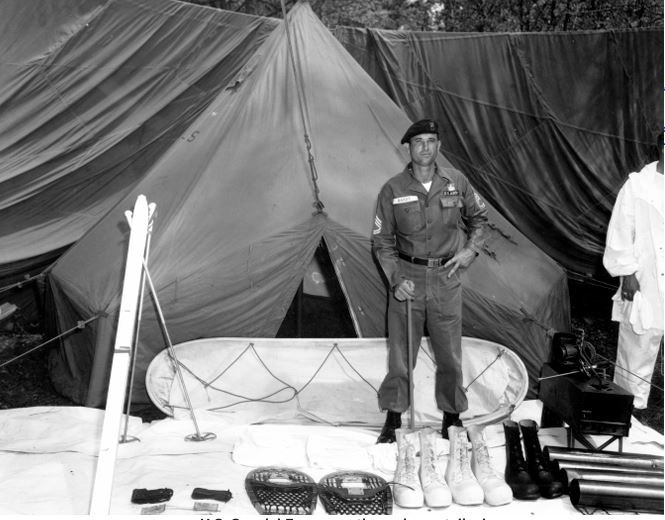
7th SFG(A), Arctic equipment display
7th SFG(A) Operation POWERPACK-1965
President Juan Emilio Bosch Gaviño, the first democratically elected president of the Dominican Republic, tried to implement a number of social reforms. These action angered the military and Dominican businessmen, who labled Bosch a communist. On September 25, 1963, a group of senior military commanders, expelled President Bosch from the country and installed Donald Reid Cabral as the new president.
On April 24, 1965, the Constitutionalistas (Constitutionalists), headed by General Francisco Caamaño, allied with the Dominican Revolutionary Party (DRP) seized the Radio Santo Domingo building and issued calls for rebellion while Constitutionalista officers distributed weapons to their civilian comrades. Gen Wessin rallied the government troops, the so-called Lealistas (Loyalists), aimed to uphold the military dictatorship and suppress the Constitutionalista rebellion. Later that day, Lealista troops, supported by armored cars and tanks, and the larger Constitutionalista forces battled over the control of Santo Domingo. One USMC battalion landed in Haina, where it provided assistance to the airlifts of civilians. On April 29, the U.S. Ambassador, reported that the situation had reached life-threatening proportions for US citizens and that the rebels were communists; called for immediate action. President Johnson authorized the transformation of evacuation operations into a large-scale military invasion through Operation Power Pack, aimed to prevent what the President saw as a second Cuban Revolution.
On April 30, 1965, the 3rd Brigade of the 82nd ABN, the 6th Marine Expeditionary Unit, elements of the 7th SFG(A); started the U.S. military intervention in the conflict. Earlier in the day, the Organization of American States (OAS) also issued a resolution calling the combatants to end all hostilities. At 4:30 p.m., representatives of the Lealistas, the Constitutionalistas, and the U.S. military signed a ceasefire that was to take effect at 11:45 p.m.
On May 5, the OAS Peace Committee arrived in Santo Domingo, and a second definite ceasefire agreement was signed, which ended the main phase of the civil war. Under the Act of Santo Domingo, the OAS was tasked with overseeing the implementation of the peace deal as well as distributing food and medication through the capital. The treaties failed to prevent some violations such as small-scale firefights and sniper fire. A day later, OAS members established the Inter-American Peace Force (IAPF) with the goal of serving as a peacekeeping formation in the Dominican Republic. The IAPF was headed by Brazilian General Hugo Panasco Alvim, with US Army General Bruce Palmer serving as his deputy commander. Utilizing Radio Santo Domingo (RSD) the rebels launched a psychological campaign against the United States, the OAS, and the Loyalists.
On May 7, 1965, the Government of National Reconstruction (GNR) was established with Antonio Imbert Barrera as president. On May 14, the GNR initiated Operation LIMPIEZA (Cleanup) an offensive against the rebel-held northern sector. By May 21, GNR troops had completed the destruction of the rebel northern zone and captured Radio Santo Domingo, and following talks with Constitutionalist leaders and Presidential Adviser McGeorge Bundy, a ceasefire was in effect by May 25.
US Army Special Forces actions during Operation POWER PACK
7th SFG(A) troops arrived 30 April with the main elements from Ft Bragg. On 4 May (D plus 4), additional troops arrived from 7th SFG(A) and 8th SFG(A) where they were sent into the countryside; Constanza, Montecristi, La Vega, Neiba, and Nagua. These 5-man teams were tasked with three missions. The overt mission was to deliver food with choppers to various locations. The second mission was gathering intelligence on popular feelings and rebel resistance, and look for signs of Cuban involvement. The third mission was to control key points if needed. The SFOB was located at Santo Domingo. LTC William N.Jackson, the Group commander, was the 7th Task Force Commander.
The most important clandestine operation during the intervention was the attempt to silence Radio Santo Domingo (RSD). Virtually every Dominican family owned a radio and, because of the country's high illiteracy rate, relied on it heavily for information. RSD, was the country's national station, capable of being heard throughout the island. In the hands of the rebels, the station became a powerful propaganda weapon-in fact, the "biggest thorn" in the side of the Americans. Langley received a telephone call from a CIA agent with a blunt message. "The difference in Santo Domingo," the agent shouted, "lies in that radio station. If the rebels continue their propaganda they will take over the entire country. The radio must be silenced!" The problem was that nothing seemed to work. Naval vessels offshore and the Army Security Agency both tried to jam RSD broadcasts, but neither had powerful enough equipment to interfere more than temporarily with the broadcasting range of a commercial station.
On 8 and 10 May, a reinforced company from the army's 7th SFG(A) led by COL Edward Mayer, mounted a successful air assault operations against RSD transmitter sites at Alto Bandero and La Vega, respectively, thereby reducing the effectiveness of RSD broadcasts in those and surrounding areas. The day after the Special Forces seized the La Vega transmitter, a team of paratroopers and Green Berets slipped into the north and severed telecommunication lines. The operation failed to shut down the radio station, but it did disrupt the telephone system used by the rebels for tactical purposes.
After the 25 May cease fire, Special Forces continued to operate in Dominican Republic. The 6th SFG(A) rotated in troops in during the next year. In addition to routine activities, the Special Forces performed several special missions. On 19 October they located, seized, and detained Constitutionalists operating an underground pro-rebel newspaper, Patria. On 23 October they reinforced Juan Bosch's personal bodyguard at his residence and after 12 January 1966 maintained surveillance on his activities. And on 17 January they covertly moved the family of Dominican Col. Montes Arache from its home in Puerto Plata, on the northern shore, to Santo Domingo.
COL Edward E Mayer
MAJ James B Oerding
Illio Capozzi
COL Francisco Alberto Caamaño Deñó


From McClusky, North Dakota LT Edward Mayer entered the US Army 1941. LT Mayer was 1 of 4 brothers who served in WW2. CPT Mayer served as an Infantry officer with 83rd ID in Europe. MAJ Mayer served with the 1st CAV in the Korean War. COL Mayer led the 7th SFG(A) operations in Dominican Republic during POWER PACK.
From Roseburg, Oregon James Oerding enlisted in the US Army 1953. PVT Oerding was assigned to the 33rd RCT of the 23rd ID in Panama. CPL Oerding graduated the West Point Prep Academy and was accepted for West Point, class of 1960. CPT Oerding served as Detachment Commander with 7th SFG(A) in operation POWER PACK. CPT Oerding served with 5th SFG(A) in Vietnam 1965-1966. MAJ Oerding served with 173rd ABN in 1967-1968.
IIlio Capozzi served in National Republican Army (Facist) of Italy during WW2. After WW2 Capozzi joined the French Foreign Legion and served in Algeria. Hired by Rafael Trujillo, the Dominica Dictator, to train the Domincan Republic Navy Frogman Corps. Capozzi and majority of the Dominican Frogman Corps sided with the Constitutionalista side of the civil war. Capozzi was killed 19 May, during a clash with Loyalist forces.
COL Caamaño was a Dominican Army officer, was one of the leaders in the movement to restore the democratically elected President Juan Bosch. After the 1965 Civil War, The Dominican Provisional President, Héctor García-Godoy, sent Colonel Caamaño to the United Kingdom as the Military Attache. In1973, Caamaño led a small group of rebels in the mountains of the Cordillera Central, with the purpose of starting a peasant revolution to overthrow Dominican President Joaquín Balaguer. After a few weeks of guerrilla war against Balaguer's regular army, Caamaño was wounded and captured by Dominican government forces, and then summarily executed.

Constitutionalistas forces in Santo Domingo, 24 April 65
Source: US Army Photo

8th SFG(A) troops supporting Operation POWER PACK
Source: US Army Photo

8th SFG(A) officer serving on the 18th ABN Corps Staff
Source: US Army Photo

Constitutionalistas question captured US Marines

Brazilian troops from the IAPF
7th SFG(A) Exercises-1965
In 1965, due to Operation POWER PACK, the 7th SFG(A) was only involved in a small number of exercises.
Exercise BIG OAKIE IV: A Joint US Army -US Airforce exercise conducted on Eglin Air Force base in February 1967, six 7th SFG(A) detachments conducted counterinsurgency operations in a jungle environment.
Exercise NATCHEZ TRACE: Conducted in April 1967, in the Natchez Trace National Forest in Tennessee. 7th SFG(A) detachments counducted counterinsurgency training with the 1st Brigade 101st ABN, prior to their deployment to Vietnam.
FTX CHEROKEE TRAIL IV and VII Conducted in central North Carolina in June and September, 7th SFG(A) Detachments supported the exercise for the Special Warfare School students
Reserve Component Training
During July, the group provided training support to the 12th SFG(A), USAR, during their annual active duty for training. The group also conducted counterinsurgency and unconventional warfare training for the 16th SFG(A) and 20th SFG(A) USANG.
7th SFG(A) Exercises-1966
FTX CHEROKEE TRAIL IV Conducted in central North Carolina in June. 7th SFG(A) Detachments supported the exercise for the Special Warfare School students
FTX HOT FOOT Conducted in Panama from April-May, where 7th SFG(A) conducted a Guerrilla Warfare exercise in a jungle environment and an evasion and escape exercise. This training was supported by the 8th SFG(A).
FTX WET SAND 7th SFG detachments conducted training with USN SEAL teams on submarine operations, to include lock-out procedures, embarking and disembarking from, small boats operations and SCUBA operations on Puerto Rico.
FTX EAGLE PREY I 7th SFG detachments conducted counterinsurgency exercise with 101st ABN in the Ft Campell area in May 1966.
FTX EAGLE PREY II 7th SFG detachments conducted a second counterinsurgency exercise with 101st ABN in the Ft Campell area in Dec 1966.

Source: US Army Photo

Source: US Army Photo
7th SFG(A) Reserve Enlisted Personnel (REP) Training-1966
The Reserve Enlisted Personnel -REP training mission was initiated by Continental Army Command -CONARC and directed to USAJFKCEN SPWAR to train, on a one-time basis, Reserve enlisted personnel in Basic Combat Training (BCT), Advanced Individual Training (AIT), and MOS Special Forces branch training. The training involved 500 Special Forces Reserve and Special Forces National Guard personnel who volunteered under the Reserve Enlistment Program and who could not, under the current training priorities, be accommodated at Army training centers. The accomplishment of this requirement will materially contribute to the Department of the Army’s Five-year (Reserve Component) Special Warfare Program. The mission of the 7th SFG(A) was to conduct BCT/AlT training under ATP 21—114 and to provide necessary logistical and administrative support for these personnel during their entire active-duty training period. Trainees started processing during the week 5-9 September. Of the 500 anticipated input, 232 SF Reserves and 250 SF National Guard personnel arrived, totaling 482. The 8-week Basic Combat Training Course commenced on 12 September and terminated 5 November 1966. On 7 November, phase l (4 weeks) of the AIT began and the first 3 weeks were completed. On 25 November, 396 trainees departed Fort Bragg by bus to Fort Benning, GA for their basic airborne training which commenced on 28 November and terminated with a DZ graduation, On 15 December, 374 trainees graduated on the drop zone; 3 graduated in the next class for a total of 377 graduates. The trainees returned from Fort Benning to the 7th SFG(A) and departed from Fort Bragg on Christmas/New Year leaves l6 December 1966. The fourth week of phase l of AlT will be conducted 3—7 January. MOS training was scheduled to commence on 9 January 1967.

7th SFG(A) instructing REP soldiers at Ft Bragg
7th SFG(A) Reserve Enlisted Personnel-REP Training-1967
During the first quarter of 1967, the 7th SFG(A) had the responsibility for the Reserve Enlisted Personnel-REP Training. The trainees were in their fourth week of training after the Christmas holidays. Phase I of AIT REP training was conducted from 3 January to 7 January. MOS training followed, beginning on 9 January and was completed on 8 May; where the student were sent to Special Forces training Group for further training. The second group of REP trainees from the USAR and ARNG Special Forces units started basic training and AIT training in Oct 1967.

2 REP soldiers firing M-79 at Ft Bragg
7th SFG(A) Exercises-1967

In 1967, the 7th SFG(A) supported a number of exercises.
Exercise CLOVE HITCH III The 7th SFG(A), USN SEAL Detachment, USAF Air Commandos, 82nd ABN and Marines participated in a JCS directed exercise conducted by Joint Special Support Operations Task Force 129 on Puerto Rico. The exercise tested joint amphibious and airborne operations and to perfect coordination and communications between participating forces.
7th SFG(A) conducted FTX April-June, at the Pisgah National Forest, and consisted of two phases, the first consisting of mountaineering, fieldcraft, patrolling, and survival training. At the completion of this training, the second phase of training was initiated at Mott Lake on the Fort Bragg reservation. This consisted of small boat, scuba, navigation, weapons, and individual MOS training.
7th SFG conducted Operational Readiness Tests-ORTs for their detachments in May-June.
Several FTXs were conducted which included summer mountain training at Northern Warfare Training Center, Fort Greely, Alaska (7-26 July), consisting of survival, mountaineering, and inland waterway operations In August 7th SFG(A) conducted small-boat training on the Cape Fear River.
FTX CHEROKEE TRAIL 7th SFG(A) Detachments supported the exercise with graders for the Special Warfare School school's student exercise.
Reserve Component Support
During July, the 7th SFG(A) conducted the evaluation of the 19th SFG(A) during an FTX at Salt Lake City, Utah. This exercise was followed by National Guard training at Fort Polk, La, and Birmingham, AL and the evaluation of the 20th SFG(A) FTX at Camp Blanding, Florida.

DZ map on Puerto Rico during CLOVE HITCH III
CPT Les Kehoe training with US troops

MAJ Leslie "Les" Kehoe
From Melbourne Australia, Leslie Kehoe joined the Australian Army in 1957. LT Kehoe graduated the Officer Cadet School , Portsea in 1958. LT Kehoe served in the Borneo Crisis in 1960-1961. In 1967 CPT Kehoe was attached to C Co 7th SFG(A). MAJ Kehoe served with the 6th Royal Australian Regiment (RAR) in Vietnam 1969.
7th SFG(A) Reserve Enlisted Personnel-REP Training-1968
The 7th SFG(A) continued the responsibility for the Reserve Enlisted Personnel-REP Training. The 7th SFG(A) conducted training for each MOS, and Advanced Andividual Training of attached reserve and national guard personnel.
7th SFG(A) Exercises-1968
The 7th SFG(A) conduted and supported a number of exercises in 1968.
Exercise ORBIT WAVE The 7th SFG(A) infiltrated detachments by parachute and established guerrilla bases in Camp A.P. Hill and Ft McClellan, AL from which they organized and trained guerrillas, while the 7th SFG(A) SFOB ran operations from Camp McKall.
7th SFG(A) conducted civil disturbance and riot controI training was conducted in preparation for Operation GARDEN PLOT contingencies.
FTX LOOKOUT In September, the 7th SFG(A) conducted training in reconnaissance, riverine navigation, ambush and demolitions. Reconnaissance was conducted on the The Carolina Power Plant, Wilmington Harbor, and other minor targets along The Cape Fear River.
In Aug-September the 7th SFG(A) parachuted into Ft. Greely, Alaska for training at the Northern Warfare Training Center. Areas covered included mountaineering, glacier operations, and riverine operations.
FTX CABIN LIGHT II In Oct, the 7th SFG(A) deployed to Panama to conduct Jungle warfare training.
Exercise GOBBLER WOODS IV 7th SFG(A) supported the Special Warfare Centers student exercises in 1968.
7th SFG(A) Reserve Component Support
7th SFG(A) provided evaluators for the 12th SFG(A) Annual Training 25 July — l8 August at Oak Park, Illinois.
Operation GARDEN PLOT
The Department of Defense Civil Disturbance Plan, also known by its Operation GARDEN PLOT, was a general US Army and National Guard plan to provide direct support to major domestic civil disturbances within the United States. This direct support of civil disturbance control operations is to be used by the Army, USAF, Navy, and Marine Corp. with an airlift force to be comprised of MAC Organic Airlift Resources, airlift capable aircraft of all other USAF major commands, and all other aerial reconnaissance and Airborne Psychological Operations. This is to include control communications systems, aeromedical evacuation, helicopter and Weather Support Systems.
7th SFG(A) Exercises-1969
FTX QUICKSAND, 7th SFG(A) conducted a UW training exercise conducted in the Green Swamp area of North Carolina.
BRASS STRIKE IV, 7th SFG(A) conducted an exercise and demonstration with the USAF 1st Air Commando Wing (SOF) at Ft Bragg
FTX WET BACK, 7th SFG(A) conducted in June at Smith Island, located two miles off the coast of South Port, North Carolina. This training was divided into three phases which inclined small boat operations, survival, and exfiltration techniques.
FTX HUNTERS MOON, 7th SFG(A) in Oct participated in combining forces with an infantry company of the 82d Airborne Division to comprise the aggressor force.
FTX ORBIT WINGS IV, This 7th SFG(A) exercise was a USAJFKCENMA directed exercise testing the deployment capabilities of a Special Forces Group participating in an MTT with subsequent UW and direct action type missions.
FTX CABIN LIGHT II, 7th SFG(A) participanted in a USAJFKCENMA directed exercise to test the training status of the 7th Special Forces Group (Abn) and portions of CINCLANT JSTF 129 OPLAN 2371 (U). A total of 24 Special Forces Operational Detachments (SFOD) were tactically deployed to Puerto Rico. The SFOD's were infiltrated utilizing all available methods; HALO, SCUBA, surface , and the conventional low altitude parachute technique.

Jet Assist Take Off (JATO) C-130 Demo during Brass Strike IV
7th SFG(A) Exercises-1970
Exercise LABILE SEARCH I On 14 Aug 1970, the 7th SFG(A) parachuted into the Canal Zone in Panama to conduct Jungle Warfare training with the 8th SFG(A).
7th SFG(A) Operation IVORY COAST-Son Tay Raid, 21 Nov 1970
Operation IVORY COAST was a mission conducted by US Army Special Forces and US Air Force aircraft and crews to rescue U.S. POWs during the Vietnam War. The specially selected raiders, from 6th SFG(A), 7th SFG(A) and Special Warfare Center, extensively trained and rehearsed the operation at Eglin Air Force Base, Florida. On 21 November 1970, launched from Thailand, US Air Force Brigadier General LeRoy J. Manor led the formation of aircraft, a mix of C-130, A-1E Skyraiders and HH-3E "Jolly Green" Helicopters carrying 56 Special Forces soldiers, commanded by Colonel Arthur D. "Bull" Simons. 59 US Navy aircraft, from the USS Ranger (CVA-61), the USS Oriskany (CVA-34), and the USS Hancock (CVA-19) flying over North Vietnam dropping flares, there was a bombing pause in effect, as a distraction. The helicopter assault started at 02:18 on the Son Tay POW (Camp Hope) camp, which was located 23 miles west of Hanoi, North Vietnam. After 28 minutes of securing and searching the target, the force departed the camp, without any prisoners. The prisoners had been recently been moved to another camp. The assault force suffered light casualties, while the North Vietnamese guard force and a local military compound suffered heavy casualties.
While the mission didn't rescue any POWs, the mission had a profound effect on the US POWs. The North Vietnamese fearing another US Raid, consolidated all US POWs together in Hanoi, where they were given better treatment and more importantly, it ended the POWs isolation. POWs from Camp Faith had heard the US rescue attempt at Son Tay and word soon spread the US had tried a rescue. The morale of the POWs was raised by the realization they hadn't been forgotten by their government.


"Raiders" training on the Son Tay Mock-up on Eglin AFB
Son Tay Raiders GREENLEAF Team Security
CSM Joseph Lupyak

From Forest City, PA Joseph Lupyak joined the US Army in 1951, serving with the 11th ABN at Ft Campbell, KY. SSG Lupyak served with the 3rd ID during the Korean war. SFC Lupyak joined Special Forces in 1954 serving with 77th SFG(A). MSG Pupyak served with Det-A in Berlin and 5th SFG(A) in Vietnam. MSG Lupyak was in 7th SFG(A), when he volunteered for Operation IVORY COAST. MSG Lupyak served on the GREENLEAF Security team for Operation IVORY COAST.
7th SFG(A) Legacy

Lao, Hmong, American Veteran Memorial
Sheboygan, Wisconsin
7th SFG(A) Contributors
Sgt Art Walker, 7th SFG(A)
Paul Miraldi
7th SFG(A) Section Notes
1 This is phase 1, of a 5-phase plan, that will cover from activation in 1960 to today.
a. Phase 1: Beginning until 62
b. Phase 2: 1963-1970
c. Phase 3: 1970-1980s
d. 1990s-2000:
e. GWOT-today
2. I am looking for the following from the 7th SFG(A):
a. Photos-preferably with story-dates
b. Stories-that need to be told/remembered
c. Documents
i. Orders, recruiting flyers / posters, unit rosters...etc.
d. FA / ODA Detachment numbers and location
i. Ft Bragg
ii. Panama
iii. Eglin AFB
3. Specific information
a. More information on Teams involved in Bay of Pigs - Operation ZAPATA
b. LTC John H Sawyer Photo and Military BIO