

On 23 May 1962, A team from 7th SFG(A) led by MajorJohn H. Sawyer, returned to the Canal Zone to begin preparations for the arrival of the advance party of D Company, 7th SFG(A). At Fort Bragg, the Special Warfare Center selected the advance party of 11 officers and 49 enlisted men from HHC of the 7th Special Forces Group. On the morning of 10 July, the advance party left by aircraft from SeymourJohnson Air Force Base. The main body of Special Forces to move to the Canal Zone was Company D, 7th SFG(A), commanded by MAJ Melvin J. Sowards. This group departed Fort Bragg on 2 August 1962 by train enroute to New York City, where they boarded the USNS GEIGER which would eventually bring the troops and their equipment to the Canal Zone. Company D docked at Pier 8 in Cristobal, Canal Zone, on 11 August. The last group to join the unit at Gulick was the augmentation detachments, on 15 August 1962, they departed Charleston Air Force Base, S.C., where they took the seven hour flight to the Canal zone. LTC Sawyer, having been promoted, assuming command of the unit. Lieutenant Colonel Sawyer remained in command of the Special Action Force throughout the remainder of 1962. Then, in January of 1963, Lieutenant Colonel Arthur D. Simons took command by receiving the colors on the Gulick parade ground from Lieutenant Colonel Sawyer, who then became the executive officer.
Under the new commander, on 1 April 1963, the unit received its official designation. Accordingly, Headquarters and Headquarters Detachment, Company D, and the augmentation units, all of the 7th SFG(A), were redesignated by General Order Number 20, Headquarters, USARCARIB, as authorized by the Deaprtment of the Army, activated the 8th SFG(A).

CPT Simons was a Company Commander in 6th Ranger BN in the Pacific theatre. CPT Simons led the mission who attacked the Japanese P.O.W. camp at Cabanatuan. LTC Simons was in charge of the 77th SFG(A) deployment to Laos in project HOTFOOT and 7th SFG(A) in project WHITE STAR. 1963 COL Simons would Command the 8th SFG(A).


USNS Geiger

8th SFG(A) Activation ceremony
COL Arthur D. "Bull" Simons
7th SFG(A), D Company Gallery


Orders Reorganizing D Co, 7th SFG(A) into 8th SFG(A)
D Co, 7th SFG(A) unit Guidon
Note: Unassigned Branch Crest, Special Forces wouldn't be a US Army branch until the 1990s.


8th SFG(A) Exercises-1963
FTX MANDINGA, conducted from 28 May until 28 June. 8th SFG(A) / 8th Special Action Force (SAF) conducted in an area on the Atlantic coast some fifty miles east of Colon. FTX Mandinga had several objectives, namely, counterinsurgency training, unit proficiency, and joint training with other U.S. and Latin American units. These were detachments from the 4th Battalion, 10th Infantry, and from Panama’s Guardia Nacional. According to the scenario, MANDINGA was the site of an imaginary country named Mooding. This small nation was troubled by general unrest, Insurgents and communist-dominated guerrilla bands controlled most of the country and had twice the strength of Mooding’s home guard who were called the Lanceros. The 8th SFG(A) /8th SAF deployed in the area from LCMs early on the morning of 28 May and were joined by the Panamanian Guardia Nacional about a week later. By this time guerrilla and counterinsurgent forces were actively engaging each other in mock combat. The FTX MANDINGA included nearly all techniques of unconventional warfare. The counterinsurgent forces organized a system of On-Call air strikes to aid in fixing and disorganizing the enemy. ln turn, the 7th SFG(A) guerrilla forces organized a successful escape and evasion net. Other combat maneuvers followed which were paralleled by civic action, medical, and psychological operations involving the local populace, particulary at the nearby village of Santa Isabel. Finally the civic action programs obtained the full support of the civilian population in all of the counterinsurgent activities. Then a final big push by the friendly forces, coordinated‘ with air strikes, effected the total disorganization of the guerrillas.
During the later months of 1963, the 8th SFG(A) / 8th SAF planned a large exercise known as "Operation GREEN BERET" throughout Panama. This project concerned all units of the 8th SAF and was a type of comprehensive MTT within Panama. Plans had been made for instruction of the Panamanian Armed Forces in counterinsurgency, psychological operations,medical operations, riot control, civic action and other fields by the 8th SFG(A) / 8th SAF. By the beginning of 1964, the teams and equipment were being deployed to various places within Panama when civil and political disturbances in the country forced the cancellation of the project.

LCM-8s "Mike Boats" of the 1097th Transportation Company (Medium Boat)
8th SFG(A) Mobile Training Teams-1963
The 8th SFG(A)/8th SAF sent over 30 Mobile Training teams to 9 Countries in 1963:
Bolivia
Airborne Training
Chile
Counterinsurgency Survey
Engineer
One Marksmanship
Medical Survey
Psychological Operations
Two Ranger Training Courses
Costa Rica
Counterinsurgency
Explosives, Ordnance and Demolitions
Signal One
Supply
Colombia
Airborne Training
2 Civic Action courses
Counterinsurgency
Signal
El Salvador
Counterinsurgency
Equador
Psychological Operations
CounterinSurgency
Supply
Guatemala
Counterinsurgency
Counter-Guerrilla
Engineer
Medical
Signal
Honduras
Counterinsurgency
Jamaica
Ordnance
Supply
Nicaragua
Engineer
Click below for Veritas article on the 8th SFG(A) MTT to El Salvador

8th SFG(A) supported Airborne Operation

9th Psyops, 8th SAF, conducting training
8th SFG(A) Panama Riots-1964
On January 9, 1964, grievances between native Panamanians and “Zonians”, or Americans residing within the U.S.-controlled Canal Zone, over the flying of US Flag without the Panamanian flag being displayed too, boiled over into a series of anti-American riots. The Panamanians had a long-standing desire for full sovereignty over the Panama Canal and the U.S.-controlled Canal Zone. The riots resulted in widespread looting, attacks on US-owned businesses, and US citizens in the evacuation of the U.S. embassy in Panama City. When the riots ended, dozens of Panamanians were killed and hundreds injured, 4 US troops; SSG Luis Jiménez Cruz, PVT David Haupt, 1SG Gerald Aubin , and SPC Michael W. Rowland were killed and another 30 U.S. military personnel were wounded in operations to control the Riots.
The 8th SFG(A) provided additional security at Ft Gulick and Solo Coco Navy Station. 8th SFG(A) Medics set up an aid station to support the US troops brought in for riot control.
Operation GREEN BERET scheduled for later in the year in Panama was cancelled as a result of the riots.

8th SFG(A) Mobile Training Teams-1964
The 8th SFG(A)/8th SAF sent over 58 Mobile Training teams to 12 Countries in 1964:
Argentina
Artillery Maintenance and Repair
Counterinsurgency Survey
Bolivia
Civic Action (Engineer)
Civic Action (USAID)
Counterinsurgency
Medical
Two Psychological Operations
Signal (Civic Action)
Chile
Air Force Survey (Joint Operation)
Marksmanship
Military Police (Signal)
Ordnance (Maintenance)
Ranger Training Course
Costa Rica
Marksmanship
Ordnance (Maintenance)
Colombia
Airborne
Airborne (Packing and Maintenance)
Civic Action (Engineer)
Two Counterinsurgency
Civic Action (Medical)
Engineer (Maintenance)
Engineer
Medical
Military Intelligence
Ordnance (Maintenance)
Ordnance
Psychological Operations
Three Signal
Dominican Republic
Counterinsurgency
Food Service Survey
Ordnance (Ammunition)
Signal
El Salvador
Airborne
Counterinsurgency
Engineer
Infantry
Ordnance
Ecuador
Counterinsurgency
Engineer
Logistical Survey
Military Intelligence
Guatemala
Counter-guerrilla
Engineer (Well Drilling)
Marksmanship
Honduras
Counter-Guerrilla
Counterinsurgency Survey
Two Engineer
Military Intelligence Survey
Jamaica
Communications Survey
Marksmanship
Signal
Nicaragua
Counterinsurgency Survey
Counterinsurgency
Engineer (Civic Action)
Ordnance

8th SFG(A) supported Airborne Operation


8th SFG(A) MTT conducting weapons training with M 20 "Super Bazooka"
8th SFG(A) conducting training in Ecuador
8th SFG(A) Operation POWERPACK-1965
President Juan Emilio Bosch Gaviño, the first democratically elected president of the Dominican Republic, tried to implement a number of social reforms. These action angered the military and Dominican businessmen, who labled Bosch a communist. On September 25, 1963, a group of senior military commanders, expelled President Bosch from the country and installed Donald Reid Cabral as the new president.
On April 24, 1965, the Constitutionalistas (Constitutionalists), headed by General Francisco Caamaño, allied with the Dominican Revolutionary Party (DRP) seized the Radio Santo Domingo building and issued calls for rebellion while Constitutionalista officers distributed weapons to their civilian comrades. Gen Wessin rallied the government troops, the so-called Lealistas (Loyalists), aimed to uphold the military dictatorship and suppress the Constitutionalista rebellion. Later that day, Lealista troops, supported by armored cars and tanks, and the larger Constitutionalista forces battled over the control of Santo Domingo. One USMC battalion landed in Haina, where it provided assistance to the airlifts of civilians. On April 29, the U.S. Ambassador, reported that the situation had reached life-threatening proportions for US citizens and that the rebels were communists; called for immediate action. President Johnson authorized the transformation of evacuation operations into a large-scale military invasion through Operation Power Pack, aimed to prevent what the President saw as a second Cuban Revolution.
On April 30, 1965, the 3rd Brigade of the 82nd ABN, the 6th Marine Expeditionary Unit, elements of the 7th SFG(A); started the U.S. military intervention in the conflict. Earlier in the day, the Organization of American States (OAS) also issued a resolution calling the combatants to end all hostilities. At 4:30 p.m., representatives of the Lealistas, the Constitutionalistas, and the U.S. military signed a ceasefire that was to take effect at 11:45 p.m.
On May 5, the OAS Peace Committee arrived in Santo Domingo, and a second definite ceasefire agreement was signed, which ended the main phase of the civil war. Under the Act of Santo Domingo, the OAS was tasked with overseeing the implementation of the peace deal as well as distributing food and medication through the capital. The treaties failed to prevent some violations such as small-scale firefights and sniper fire. A day later, OAS members established the Inter-American Peace Force (IAPF) with the goal of serving as a peacekeeping formation in the Dominican Republic. The IAPF was headed by Brazilian General Hugo Panasco Alvim, with US Army General Bruce Palmer serving as his deputy commander. Utilizing Radio Santo Domingo (RSD) the rebels launched a psychological campaign against the United States, the OAS, and the Loyalists.
On May 7, 1965, the Government of National Reconstruction (GNR) was established with Antonio Imbert Barrera as president. On May 14, the GNR initiated Operation LIMPIEZA (Cleanup) an offensive against the rebel-held northern sector. By May 21, GNR troops had completed the destruction of the rebel northern zone and captured Radio Santo Domingo, and following talks with Constitutionalist leaders and Presidential Adviser McGeorge Bundy, a ceasefire was in effect by May 25.
US Army Special Forces actions during Operation POWER PACK
7th SFG(A) troops arrived 30 April with the main elements from Ft Bragg. On 4 May (D plus 4), additional troops arrived from 7th SFG(A) and 8th SFG(A) where they were sent into the countryside; Constanza, Montecristi, La Vega, Neiba, and Nagua. These 5-man teams were tasked with three missions. The overt mission was to deliver food with choppers to various locations. The second mission was gathering intelligence on popular feelings and rebel resistance, and look for signs of Cuban involvement. The third mission was to control key points if needed. The SFOB was located at Santo Domingo. LTC William N. Jackson, the Group commander, was the 7th Task Force Commander.
The most important clandestine operation during the intervention was the attempt to silence Radio Santo Domingo (RSD). Virtually every Dominican family owned a radio and, because of the country's high illiteracy rate, relied on it heavily for information. RSD, was the country's national station, capable of being heard throughout the island. In the hands of the rebels, the station became a powerful propaganda weapon-in fact, the "biggest thorn" in the side of the Americans. Langley received a telephone call from a CIA agent with a blunt message. "The difference in Santo Domingo," the agent shouted, "lies in that radio station. If the rebels continue their propaganda they will take over the entire country. The radio must be silenced!" The problem was that nothing seemed to work. Naval vessels offshore and the Army Security Agency both tried to jam RSD broadcasts, but neither had powerful enough equipment to interfere more than temporarily with the broadcasting range of a commercial station.
On 8 and 10 May, a reinforced company from the army's 7th SFG(A) led by COL Edward Mayer, mounted a successful air assault operations against RSD transmitter sites at Alto Bandero and La Vega, respectively, thereby reducing the effectiveness of RSD broadcasts in those and surrounding areas. The day after the Special Forces seized the La Vega transmitter, a team of paratroopers and Green Berets slipped into the north and severed telecommunication lines. The operation failed to shut down the radio station, but it did disrupt the telephone system used by the rebels for tactical purposes.
After the 25 May cease fire, Special Forces continued to operate in Dominican Republic. The 6th SFG(A) rotated in troops in during the next year. In addition to routine activities, the Special Forces performed several special missions. On 19 October they located, seized, and detained Constitutionalists operating an underground pro-rebel newspaper, Patria. On 23 October they reinforced Juan Bosch's personal bodyguard at his residence and after 12 January 1966 maintained surveillance on his activities. And on 17 January they covertly moved the family of Dominican Col. Montes Arache from its home in Puerto Plata, on the northern shore, to Santo Domingo.
MAJ George Petrie Jr

Born in Lenoir, North Carolina, Sgt Petrie joined Special Forces in 1961, where he served as a radio operator and light weapons specialist with the 5th SFG(A) from 1961 to 1963. SGT Petrie deployed to the Republic of Vietnam in 1963. He then served with the 8th SFG(A) in Panama, deploying to the Dominican Republic in 1965, followed by another tour in South Vietnam with the 5th Special Forces Group from 1967 to 1968. Petrie then served with the 3rd SFG(A) and the 6th SFG(A), receiving a direct commission to 1st Lt on January 23, 1970. Lt Petrie participated in the Son Tay Raid on November 21, 1970.

Constitutionalistas forces in Santo Domingo, 24 April 65
Source: US Army Photo

8th SFG(A) troops supporting Operation POWER PACK
Source: US Army Photo

8th SFG(A) officer serving on the 18th ABN Corps Staff
Source: US Army Photo

Constitutionalistas question captured US Marines

Brazilian troops from the IAPF

IIlio Capozzi served in National Republican Army (Facist) of Italy during WW2. After WW2 Capozzi joined the French Foreign Legion and served in Algeria. Hired by Rafael Trujillo, the Dominica Dictator, to train the Domincan Republic Navy Frogman Corps. Capozzi and majority of the Dominican Frogman Corps sided with the Constitutionalista side of the civil war. Capozzi was killed 19 May, during a clash with Loyalist forces.
Illio Capozzi

COL Caamaño was a Dominican Army officer, was one of the leaders in the movement to restore the democratically elected President Juan Bosch. After the 1965 Civil War, The Dominican Provisional President, Héctor García-Godoy, sent Colonel Caamaño to the United Kingdom as the Military Attache. In1973, Caamaño led a small group of rebels in the mountains of the Cordillera Central, with the purpose of starting a peasant revolution to overthrow Dominican President Joaquín Balaguer. After a few weeks of guerrilla war against Balaguer's regular army, Caamaño was wounded and captured by Dominican government forces, and then summarily executed.
COL Francisco Alberto Caamaño Deñó
8th SFG(A) Exercises -1965
1965 exercises.
Exercise LAGUNA I 8th SFG(A), 196th Infantry Brigade and Panamaian National Guard conducted Mar-April.
Exercise COLD STEEL II and III 8th SFG(A) conducted counterinsurgency training with the 196th Infantry Brigade.
8th SFG(A) Exercises - Mobile Training Teams-1965
The 8th SFG(A)/8th SAF sent over 61 Mobile Training teams to 15 Countries in 1965:
Argentina
Bolivia
Brazil
Chile
Colombia
Costa Rica
Dominican Republic
Ecuador
El Salvador
Guatemala
Honduras
Jamaica
Nicaragua
Panama
Peru
Uraguay
Venezuela
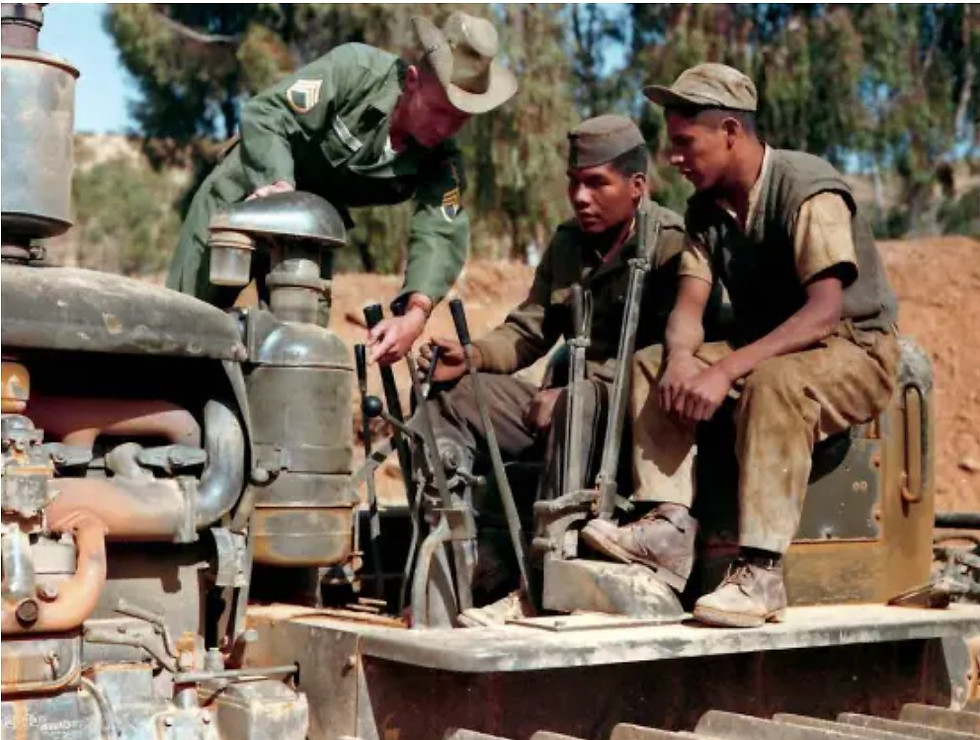
8th SFG(A) teaching Engineer operations in Bolivia
Source: US Army Photo
8th SFG(A) Exercises -1966
The 8th SFG(A) participated in a number of exercises in 1966:
Exercise SEABREEZE-SAVAGE TRADE 8th SFG(A), USAF 605th Air Commandos and 20th INF conducted an Unconventional Warfare exercise and Counterinsurgency training from Oct-Dec in Puerto Rico.
FTX BLACK PALM 8th SFG(A), 20th INF and Panamanian National Guard conducted counterinsurgency training in April
FTX GAMBOA Guerrilla Warfare and Counterinsurgency exercise in conducted in June by 8th SFG(A)
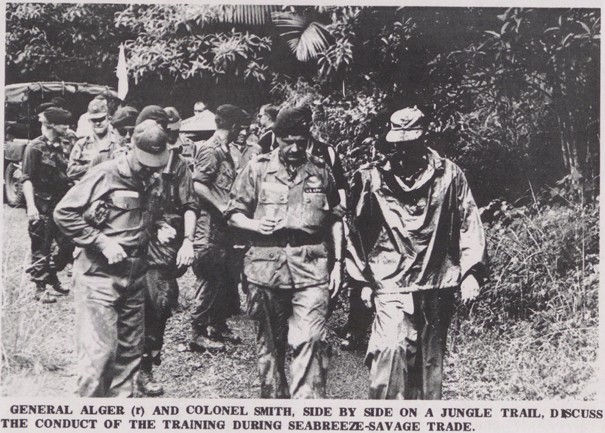
Source: US Army Photo

8th SFG(A) Exercises -1967
The FTX SEABREEZE-SAVAGE FOLLIES I, a joint field training exercise, was held from November 20th through December 19th with the 4/10th and 4/20th Infantry Battalion 8th SFG(A) and 605th Air Commando Squadron.
8th SFG(A) Mobile Training Teams-1967
The 8th SFG(A)/8th SAF sent over 61 Mobile Training teams to 19 Countries in 1967:
Bolivia
Brazil
Chile
Columbia
Costa Rica
Dominican Republic
Ecuador
El Salvador
Guatemala
Honduras
Jamaica
Nicaragua
Panama
Paraguay
Peru
Puerto Rico
Uruguay
Venezuela

8th SFG(A) Mobile Training Team
8th SFG(A) MTT Bolivia -1967
On 3 Nov 1966, Che Guevara and a small cadre of Cubans entered Bolivia. The group believed once the Bolivian guerrilla vanguard was firmly established, it would train and support other revolutionary movements (focos) in Peru, Argentina, Brazil, and Paraguay. The Peruvian foco was scheduled for the end of 1967. In March 1967, Che started his guerrilla offensive against the Bolivian military. From March to April, the Bolivian military suffered heavy casualties from the guerrillas, resulting in the Bolivian President Barrientos requesting US support from the Johnson administration.
On 29 April 1967 Two C-130 Hercules cargo aircraft flew from Howard AFB, Panama to Bolivia. The aircraft carried fourteen SF officers and sergeants, personal and unit equipment, training materials, and supplementary foods to support a deployment for up to 179 days. The mission, led by MAJ Ralph Shelton, was to organize, equip, and train a Ranger Battalion for the Bolivian Army. The 17-week training program ended 19 Sep 1967. The Bolivian 2nd Ranger Battalion was quickly deployed to the area where Guevara's group was suspected to located.

8th SFG(A) MTT Bolivia, MAJ Ralph Shelton Center
Courtesy Veritas Magazine

MAJ Ralph "Pappy" Shelton
From Corinth MS, Ralph Shelton joined the US Army in 1945 as a Tanker. SGT Shelton served with the 1st Cav and 24th ID in the Korean War. LT Shelton graduated OCS in 1957. CPT Shelton joined Special Forces in 1961 and served with 7th SFG(A) in Laos.
8th SFG(A) MTT Bolivia 1967

8th SFG(A) MTT Bolivia
The Big Picture TV- 686 US Army in Andes
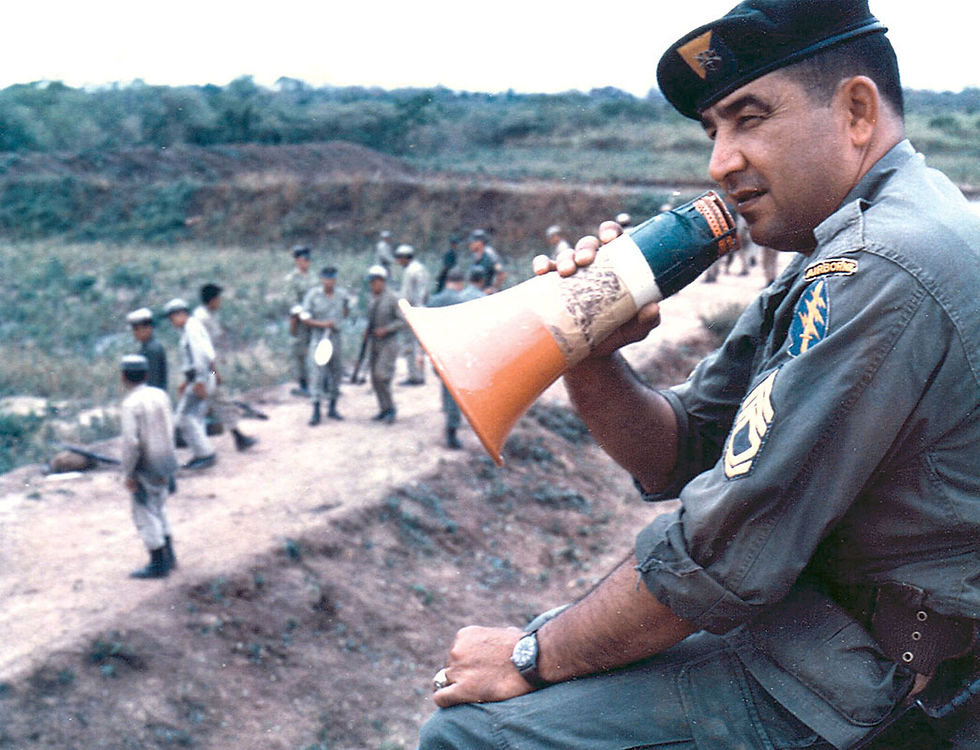
8th SFG(A) MTT Bolivia
Courtesy Veritas Magazine

8th SFG(A) MTT Bolivia
Courtesy Veritas Magazine
8th SFG(A) MTT Bolivia MOU

Memorandum of Understanding for 8th SFG(A) training support between the US Army MILGP and Bolivian Army
Source: NSA Archives, George Washington University


8th SFG(A) Bolivia 7-9 Oct 1967
The Bolivian 2nd Ranger Battalion arrived in the region on 26 Sep 1967, just weeks after completing training with the 8th SFG(A). On 7 October 1967, a local farmer had reported seeing 17 men entering a local canyon to the Bolivian Army. The Bolivian Rangers encircled the area with two companies and advanced, triggering a battle where Guevara was wounded and taken prisoner while leading a detachment with Simeon Cuba Sarabia, a Bolivian national. Guevara and Sarabia were tied up and taken to a dilapidated mud schoolhouse in the village of La Higuera on the evening of 8 October. The next morning, on orders from the Bolivian President Barrientos, they were executed by Bolivian troops. In the fighting that lasted until 14 October, the Rangers had nine men killed in action and four wounded. Of Che’s force, eleven were killed, one captured, and five (three Cubans and two Bolivians) escaped into Chile.
Click below for Veritas article on the Capture of Che Guevara

Che Guevara captured by Bolivian Rangers
8th SFG(A) Reports on Death of Che Guevara
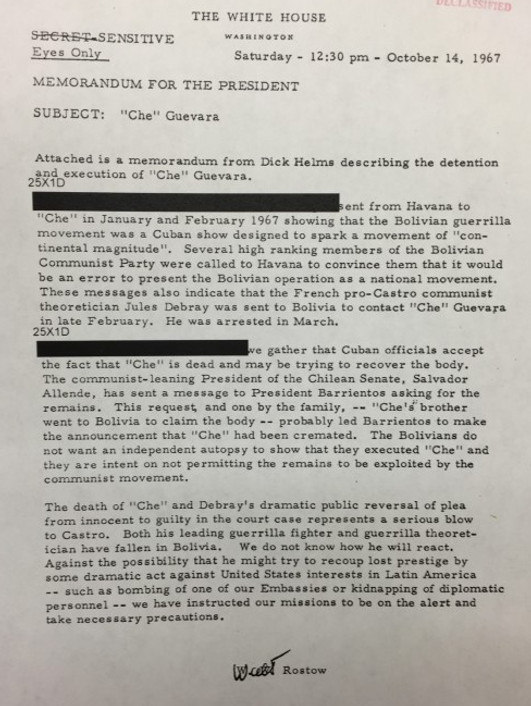

CIA memo-Death of Che Guevara
Washington Star Newspaper article-Death of Che Guevara
8th SFG(A) Exercises -1968
The 8th SFG(A) conducted a number of exercises in 1968
Exercise IGUANA I 8th SFG(A) unit training for A-team conducting raids, with emphasis on planning, Reconniaissance, water infiltration
Exercise IGUANA II 8th SFG(A) exercise training Special Forces skills
Exercise IGUANA III 8th SFG(A) and USAR Air Commando conducted training on Puerto Rico with teams, lasting 6 weeks
Operation NICARAO in April, 8th SFG(A) ODAs training 3 guerrilla Nicaraguans against a counterinsurgency force made of troops from El Salvador, Guatemala, Honduras and Nicaragua and US 508th Airborne BN.
FTX HALCON VISTA III in May-June 8th SFG(A), with USAF, USN elements, conducting surveillance training

8th SFG(A) Mobile Training Teams-1968
8th SFG(A) sent 53 MTTs to 13 different countries in 1968
Argentina
Bolivia
Chile
Colombia
Costa Rica
Dominican Republic
Ecuador
El Salvador
Guatemala
Honduras
Nicaragua
Panama
Paraguay
Uraguay
Venezuela


8th SFG(A) Exercises -1969
The 8th SFG(A) conducted a number of exercises in 1969
Exercise IGUANA IV 8th SFG(A) unit training weapons and demolition
Exercise IGUANA II 8th SFG(A) unit training on medical skills
Exercise IGUANA III 8th SFG(A) unit training on communications
Exercise IGUANA IV 8th SFG(A) unit training on operations and intelligence
FTX IGUANA BLACK I April-June, 8th SFG(A) conducted a CIVIC Action / MEDCAP on Puerto Rico.

8th SFG(A) Mobile Training Teams-1969
8th SFG(A) sent 23 MTTs to 19 different countries in 1969
Argentina
Bolivia
Brazil
Chile
Colombia
Costa Rica
Dominican Republic
Ecuador
El Salvador
Guatemala
Honduras
Jamiaca
Nicaragua
Panama
Paraguay
Peru
Uraguay
Venezuela
Puerto Rico

8th SFG(A) The Football War, 14-18 July 1969
Social, economic, and territorial tensions had created an increasingly volatile relationship between Honduras and El Salvador in the late 1960s. In June 1969, both countries met in a two-leg 1970 FIFA World Cup qualifier. With a match played in each country, that lead to fan-based violence and riots resulting in deaths. On 26 June 1969, El Salvador dissolved all diplomatic ties with Honduras. After El Salvador won the third match, scheduled in nuetral Mexico City, 12,000 El Salvadorans were forced to flee Honduras due to Anti-El Salvador violence.
The war began on 14 July 1969, when the El Salvador Airforce attacked Honduran airfields using WW2 Mustangs, as well as C-47s and civilian aircraft as improvised bombers. They targeted the Honduran Air Force kept aircraft at the Toncontín International Airport. The Salvadoran Army then launched a two-front invasion of Honduras; one column of troops headed to Santa Rosa de Copan, while the main effort marched along the Pan-American Highway toward Tegucigalpa, the Honduran Capitol. The El Salvador troops were supported by M3A1 Stuarts, improvised APCs built on trucks and artillery pushed back the lightly armed Honduran Army. On 15 July, the Honduran Air Force commenced bombings using their own fleet of WW2 Corsairs, resulting in El Salvador losing a large percentage of its fuel reserves. On 16 July, in the only major battle of the war, Salvadoran troops reached and surrounded Nueva Ocotepeque. Following artillery barrages, Honduran forces retreated alongside civilians, leading to the town's capture. Both fronts stalled later that day due to an ammunition, fuel shortages and increasing Honduran resistance. On July 18 pressure by the Organization of American States (OAS) forced the Salvadorans to agree to a ceasefire.
The Football War was the last conflict in which piston-engined fighters fought each other.
8th SFG(A) would supply troops to the OAS 30-man Inter-American group of military observers emplaced after the ceasefire.
The nearly 300,000 displaced Salvadorans from Honduras, disrupted the economies of both countries for years later and contributed to the Civil War in El Salvador.
8th SFG(A) Exercises-1970
The 8th SFG(A) conducted a number of exercises in 1970
Exercise UFANS Group exercise conducted in January
FTX NOMAD June Airborne infilltration, Water infilltration and Aerial resupply
FTX Lightning conducted in October, with SFOB infilling teams into a Unconventional Warfare Area
CPX ALCOTAN UNCO Group Exercise conducted in Dec
8th SFG(A) MTTs-1970
8th SFG(A) sent 26 MTTs to 13 different countries in 1970
Argentina
Bolivia
Colombia
Costa Rica
Dominican Republic
El Salvador
Guatemala
Honduras
Nicaragua
Panama
Paraguay
Peru
Venezuela
8th SFG(A) Mobile Training Teams-1971
8th SFG(A) conducted a number of MTTs in 15 different countries in 1971
Argentina
Bolivia
Chile
Colombia
Costa Rica
Dominican Republic
El Salvador
Guatemala
Honduras
Nicaragua
Panama
Paraguay
Peru
Uruguay
Venezuela
8th SFG(A) Deactivation, 3 May 1972
On 3 May 1972, 8th SFG(A) was deactivated and 3rd BN, 7th SFG(A) was activated.
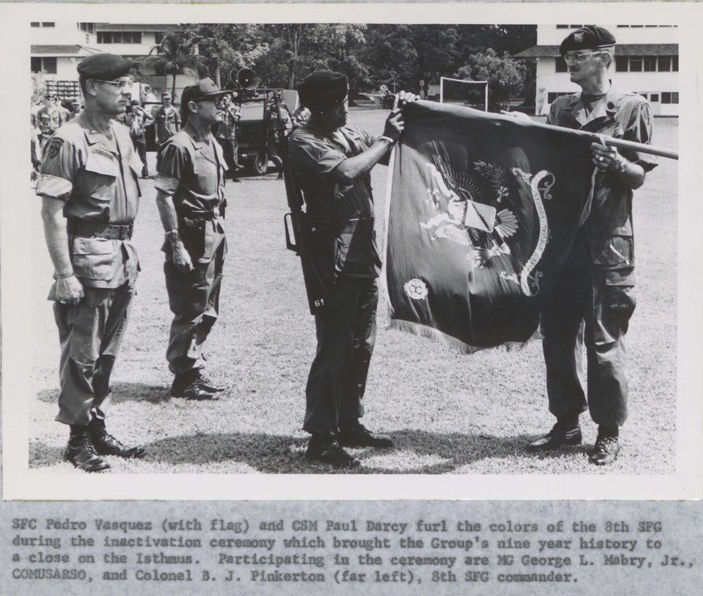
8th SFG(A) Inactivation Ceremony
3 May 1972

3rd Bn 7th SFG(A) Activation Ceremony
3 May 1972
8th SFG(A) Deactivation Documents


8th SFG(A) Deactivation Orders, 3 May 1972
3 rd Bn, 7th SFG(A) Activation Orders, 4 May 1972
8th SFG(A) Gallery

8th SFG(A) Payday formation
US Army Image

8th SFG(A) Unit Sign

8th SFG(A)
Source: US Army Photo


8th SFG(A) Legacy


The Big Picture TV- 685 Your Army Reports
The Big Picture TV- 686 US Army in Andes
6 min DOD film about the 8th SFG(A) conducting HALO training
28 Min DOD film about the 8th SFG(A) conducting a MTT in Bolivia
8th SFG(A) Project Notes
1 This is phase 1, of a 2-phase plan, that will cover from activation in 1963 to today.
a. Phase 1: Beginning until 68
b. Phase 2: 1968-1972
2. I am looking for the following from the 8th SFG(A):
a. Photos-preferably with story-dates
b. Stories-that need to be told/remembered
c. Documents
i. Orders, recruiting flyers / posters, unit rosters...etc.
d. FA / ODA Detachment numbers and locations
i. Panama
ii. MTTs